The Collector's Handbook: Rarity, Storage, Grading, and Fakes

Know What You're Holding: Rarity Symbols Decoded
Before you can protect, grade, or sell a card intelligently, you need to understand what it is. Each of the three major TCGs uses a distinct rarity system, and conflating them is one of the most common mistakes new collectors make.
Magic: The Gathering has used a color-coded set symbol since the Exodus expansion in 1998. The symbol sits between the art and the text box: black for Common, silver for Uncommon, gold for Rare, and orange/red for Mythic Rare. On modern cards, the bottom-left corner also carries a collector number and a letter code — C, U, R, or M — which is the fastest way to confirm rarity at a glance. Beyond that baseline, MTG layers in special treatments: borderless, extended art, showcase frames, and serialized versions (numbered like "123/500") that appear exclusively in Collector Boosters. A serialized Mythic is effectively a one-of-a-kind object, and the market prices it accordingly.
Pokémon TCG (Scarlet & Violet era) uses a tiered system printed in the lower-left of each card: Common (circle), Uncommon (diamond), Rare (star), Double Rare (two stars), Ultra Rare (three stars), Illustration Rare (one star with a paintbrush icon), Special Illustration Rare (two stars with the same icon), and Hyper Rare (full gold card). The set code and card number — Surging Sparks is sv8, so Pikachu ex #179 is sv8/191 — let you look up any card instantly on resources like Bulbapedia or PkmnCards. Higher collector numbers within a set almost always signal higher rarity; if you pull a card numbered above the set's official total, you're holding something special.
One Piece Card Game organizes cards into: Common (C), Uncommon (UC), Rare (R), Super Rare (SR), Secret Rare (SEC), and Leader (L). Alternate Art (AA) and Manga Rare variants exist as premium treatments layered on top of those tiers. The set code format is consistent: OP-01 is Romance Dawn, OP-02 is Paramount War, and so on. The card number printed after the set code (e.g., OP01-025 for Roronoa Zoro) is your anchor for identifying a specific card and treatment. A Parallel Rare with a holographic finish is a distinct SKU from the standard print — and it prices differently, sometimes dramatically so.
Storage and Protection: A Layered System
The enemy isn't time — it's humidity, UV light, surface friction, and pressure. Get the layering right and cards stored today will look pristine in a decade.
The standard protection stack:
| Layer | Product | Purpose |
|---|---|---|
| 1 | Penny sleeve (soft polypropylene) | Block surface scratches and fingerprint oils |
| 2 | Top loader (35pt for standard cards; 55–130pt for thick foils or Japanese cards) | Rigid bend prevention |
| 3 | Team bag or resealable sleeve over the top loader | Dust and moisture seal |
For bulk commons and playsets, a 4-pocket or 9-pocket binder with acid-free pages works well — but always penny sleeve first. The sleeve creates a barrier between the card and the binder page, which matters especially for foil surfaces that can stick and scratch. For anything worth more than a few dollars, rigid protection is non-negotiable: a top loader costs a few cents, and discovering a bent $50 card costs $50.
Climate is more important than most collectors realize. The ideal storage environment is 65–72°F (18–22°C) with 40–50% relative humidity. Attics, garages, and basements are unsuitable: they experience temperature swings that warp cards and humidity spikes that encourage mold. A dedicated interior closet, or a dehumidified storage box with silica gel packs, is the practical solution. Stand binders and storage boxes upright like books — never stack them flat under weight, which applies pressure to corners and edges.
For graded slabs (PSA, CGC, BGS), the same environmental rules apply. Store slabs in foam-lined cases or dedicated slab boxes, away from direct sunlight, which degrades both the card and the slab's UV coating over long periods.
Value your collection and track which cards need better protection with Cardbrd's scanning tools — a quick scan tells you which cards in that binder deserve an upgrade to a hard case.
Spotting Fakes: What to Check Before You Buy
Counterfeiting has intensified across all three games. In early 2025, high-value Pokémon prototype cards believed to date from the 1990s were exposed as fakes after forensic checks revealed hidden printer marks from 2024 — cards linked to a retired Creatures Inc. employee that caused significant losses for buyers. In August 2024, a serious warning came from graders about counterfeit Monkey D. Luffy Alternate Art Manga Rare cards in the One Piece TCG, featuring slight changes in font thickness, card texture, and authenticity stamp clarity. Fake PSA and CGC slabs have also been documented, which means physical authentication skills matter even for cards already in holders.
Run through this checklist on any high-value purchase:
- Light test: Hold the card edge-on to a strong light source. Authentic Pokémon and MTG cards have a thin black inner layer (the "black core") visible at the edge; some One Piece Japanese prints use a blue core. Fakes frequently show no distinct layer or the wrong color.
- Font and text: Blurry fonts, incorrect letter spacing, missing accent marks (Pokémon's accent on the é is a common fake failure point), or misaligned text boxes are reliable red flags. Compare against a high-resolution scan on an official database like Scryfall (MTG) or the official One Piece Card Game site.
- Card weight: Authentic cards have a consistent weight. A jeweler's scale set to grams can flag outliers — fakes are often measurably lighter.
- Color saturation: Counterfeit cards frequently oversaturate colors or print them slightly off-register. Gradients in the art are the easiest place to spot this.
- Card back: The Pokémon card back is one of the most replicated elements in the hobby and one of the hardest to fake precisely. Any fuzziness in the blue border or inconsistent Poké Ball linework is a red flag.
- Seller signals: Blurry listing photos, prices dramatically below market, or terms like "custom," "proxy," or "reproduction" in the description are warning signs. For purchases above $50, always request in-hand video and cross-reference the card's condition against PSA or CGC population report data.
If you're uncertain about a card you already own, a grading company submission will authenticate it — and if it comes back genuine, you get a slabbed card in return.
Grading Basics: When It Makes Sense (and When It Doesn't)
Professional grading — submitting a card to PSA, CGC, or BGS, who evaluate it on a 1–10 scale and seal it in a tamper-evident case — is not right for every card. The economics have to work.
The four criteria every grader evaluates: centering (front and back), corners, edges, and surface. A PSA 10 (Gem Mint) requires near-perfect scores across all four. A small factory print defect can drop a card to a PSA 9, which typically sells for significantly less — sometimes less than half the PSA 10 value on high-demand cards.
PSA is the liquidity leader. PSA 10 slabs consistently command the highest secondary market prices, which matters at resale. PSA has raised submission prices multiple times in 2025–2026; a Collectors Club membership ($149–$199/year) is now required to access value-tier bulk pricing. Without membership, a one-off submission through the GameStop PSA partnership runs approximately $22 per card — a reasonable entry point for testing the process. CGC has grown aggressively: it graded 451,000 cards in February 2026 alone, up 57% year over year, and its list of most-graded cards in late 2025 was dominated entirely by One Piece TCG submissions. A CGC Gem Mint 10 typically sells for 15–25% less than a PSA 10 for the same card, though that gap is closing on modern TCGs. BGS provides four visible sub-grades on each slab (centering, corners, edges, surface), which makes it uniquely useful for understanding exactly where your cards are falling short — valuable feedback if you're learning to self-assess before submitting.
Grading makes sense when: you pulled a chase card in near-mint condition from a fresh pack, the raw-to-PSA-10 price premium covers the submission cost with room to spare, or you want long-term authentication and protection for a key set cornerstone. It does not make sense for bulk commons, heavily played cards, or any card where the realistic PSA 10 premium is smaller than what you'll spend submitting it.
Top Mover Spotlight: Roronoa Zoro (OP01-025)
The card to watch right now is Roronoa Zoro from Romance Dawn (OP01-025), the Super Rare from the inaugural English One Piece TCG set and one of the franchise's defining collector anchors.
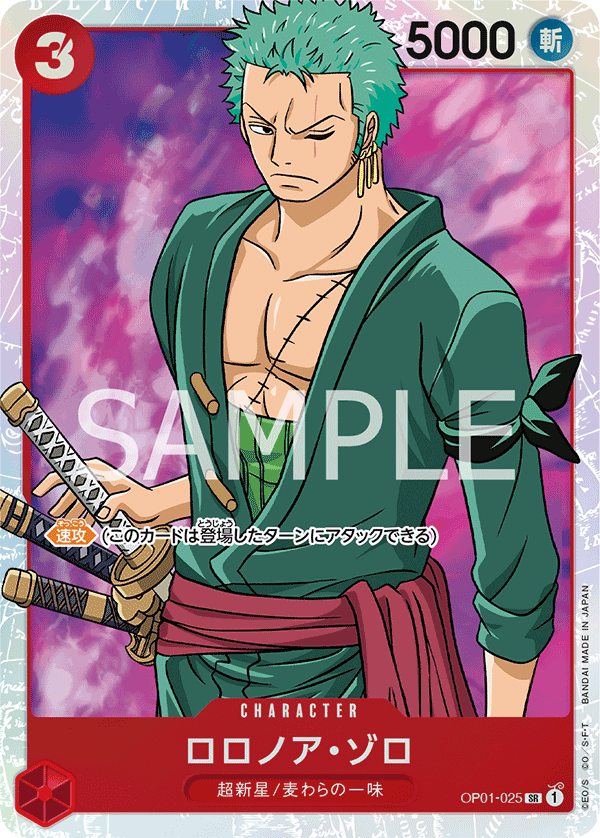
On Cardbrd, Zoro OP01-025 is currently priced at $7.75 ungraded and $110 in PSA 10 — a roughly 14× raw-to-slab premium. That ratio is worth paying attention to. Romance Dawn (OP-01) already has over 50,000 individual cards logged in PSA's population report, reflecting the set's strong collector following, but gem-mint supply is structurally capped: OP01 packs have been out of active print rotation for some time, and raw card quality diminishes as more copies circulate through play and trade. A Super Rare from the first-ever English set, featuring the franchise's most iconic swordsman, has the kind of origin-set provenance that tends to hold and grow value over multi-year holds. If you're considering a submission, the economics are favorable — the PSA 10 premium far exceeds current submission costs at any tier.
track Roronoa Zoro on Cardbrd to follow price movement and set a buy or submission target.
Every skill in this guide — reading set codes, layering protection, authenticating purchases, running the grading math — compounds over time. The collectors who get it right early protect their money and their cards simultaneously. Scan your collection on Cardbrd for free and get current values across Pokémon, One Piece, and Magic: The Gathering in one place.
Sources
- How to Spot Fake Pokémon & One Piece TCG Cards — DX Collection
- Complete One Piece TCG Grading Guide: PSA, CGC, BGS — OPTCG
- MTG Card Rarity Explained: Symbols, Value & Guide (2026) — QPM
- How to Store Your Trading Card Collection: Complete Guide — Card Shellz
Cover photo: Photo by Giorgio Trovato on Unsplash.