Grading Economics in 2026: When the PSA Math Actually Works

The PSA Price Hike Changes the Calculation
Grading is no longer cheap. PSA raised prices on Value Bulk, Value, Value Plus, Value Max, and Regular service levels in February 2026 — each tier increased by a flat $5. Value Bulk specifically moved from $21.99 to $24.99, and turnaround times have also increased on select tiers as submission volume continues to outpace grading capacity.
That context matters enormously when you're deciding whether to slab a card. The rule is simple: the PSA 10 premium has to meaningfully exceed your all-in cost — grading fee, round-trip shipping, the cost of the raw card, and time waiting. Right now, that bar is higher than it was a year ago. Submit a card that misses a 10 and you've often turned a small gain into a loss.
When the Numbers Work — and When They Don't
Umbreon ex (Prismatic Evolutions #161) is currently around $1,585 ungraded on Cardbrd, with a PSA 10 sitting at approximately $6,600. That's a premium of over $5,000 on a card that already has a four-figure raw price. Even at current PSA fees, the math is straightforward: if you pull or source a clean copy, submitting it is essentially mandatory. The only meaningful risk is condition — Prismatic Evolutions has been notorious for print quality issues, so inspect edges and centering carefully before you commit to a submission.
One Piece Romance Dawn singles require sharper pencil work. At current Cardbrd values, Roronoa Zoro (OP01-025) is $7.12 raw and $107.25 as a PSA 10 — roughly a 15× multiplier. But at $24.99 for Value Bulk plus $15–20 round-trip shipping, you're spending $40–45 per card just to get it back. On a $7 raw card, a PSA 9 outcome (worth $30–40 for many OP01 singles) turns the transaction into a loss. The smarter move: batch submissions of 10–15 cards to bring per-card cost down, and only include cards you're genuinely confident grade at a 10.
Top Mover Spotlight: Roronoa Zoro (Romance Dawn OP01-025)
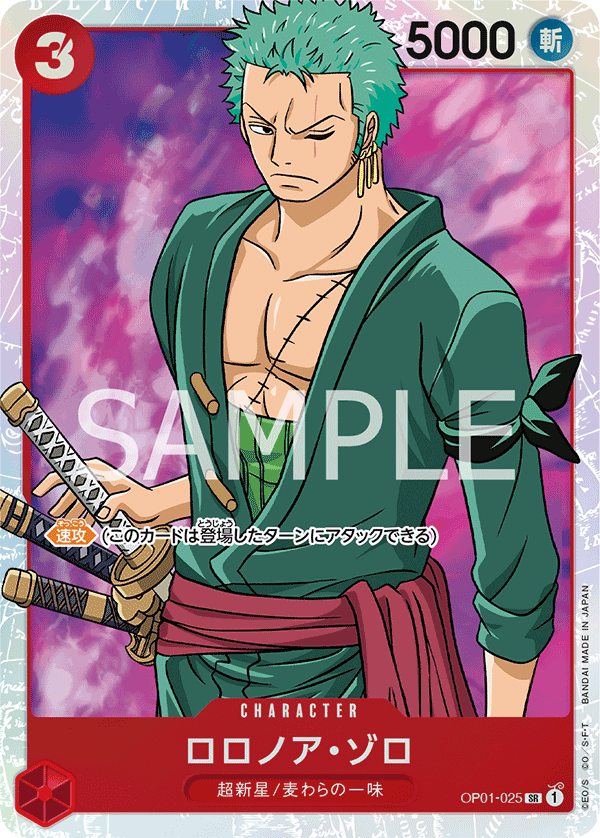
Zoro (OP01-025) is the clearest illustration of where One Piece grading premiums come from. At $7.12 raw and $107.25 PSA 10, the gap reflects both collector demand for a flagship character and the structural supply problem facing OP01. Romance Dawn was significantly underprinted at launch — Bandai prioritized later sets — leaving early sealed product permanently scarce, with sealed boxes now treated as alternative-asset stores by some collectors. That same scarcity logic flows downstream to graded singles.
The near-term catalyst worth watching: OP-16 "The Time of Battle" dropped in English on June 12, 2026, alongside Double Pack Set DP-11 and the ST-30 Starter Deck. New set launches historically push fresh buyers toward the hobby, and those newcomers eventually discover OP01 chase cards. The discovery cycle is slow but reliable.
Compare Zoro to his set-mate, Shanks (OP01-120) — currently $8.46 raw and $94.50 PSA 10 on Cardbrd. Shanks commands a higher raw price but a slightly lower PSA 10 ceiling, likely reflecting Zoro's broader fan base. If you're choosing between the two for a batch submission, Zoro's higher upside on a graded outcome gives it the edge in pure return-on-submission math.
Sealed vs. Singles: The Honest Trade-Off
The One Piece TCG market currently operates as a dual-speed economy: high-end singles occupy a space defined by scarcity where price is secondary to ownership, while sealed product is defined by competitive pricing and high turnover.
For OP01 sealed, the argument is structural — supply is fixed and not coming back — but secondary market prices already reflect that. The margin for error on sealed OP01 is thin unless you sourced it early. For OP-16, the calculus flips: supply is at its peak right now, which means non-chase singles will likely dip 4–8 weeks post-release as initial hype fades. If you're targeting specific cards from the new set, mid-to-late July 2026 is a more disciplined entry point than buying today. The exception is any card already showing breakout demand in week one — waiting on those means chasing, not buying.
Value your collection on Cardbrd to monitor which cards are climbing before you decide.
A Practical Decision Framework
| Scenario | Recommended Action |
|---|---|
| PSA 10 premium is 10× or more over raw | Grade; batch submissions to reduce per-card cost |
| PSA 10 premium is 3–5× over raw | Grade only if raw cost is under $20 and condition is excellent |
| Raw card under $15, uncertain condition | Hold raw or sell raw — grading fees erode upside |
| Flagship character, first-edition set (OP01) | Grade near-mint copies; slab demand holds long-term |
| New set just launched | Wait 4–6 weeks on singles; buy sealed only at or near MSRP |
The Umbreon ex situation is real — some pulls genuinely warrant grading — but it's an outlier, not a template. Most cards will never generate a PSA 10 premium that justifies the 2026 fee structure at their raw price point. Know which bucket your card sits in before you seal that submission envelope.
Start tracking your cards and running the math at cardbrd.io — it's free, and it takes less time than a bad grading decision.
Sources
- PSA Pricing and Turnaround Time Updates — PSA
- PSA Grading Prices Increase Again in 2026 — DK Network
- One Piece TCG Prices 2026: Complete Value & Investment Guide — TCG Aegis
- Product Calendar One Piece Card Game — Man of Games
Cover photo: Photo by Thimo Pedersen on Unsplash.